
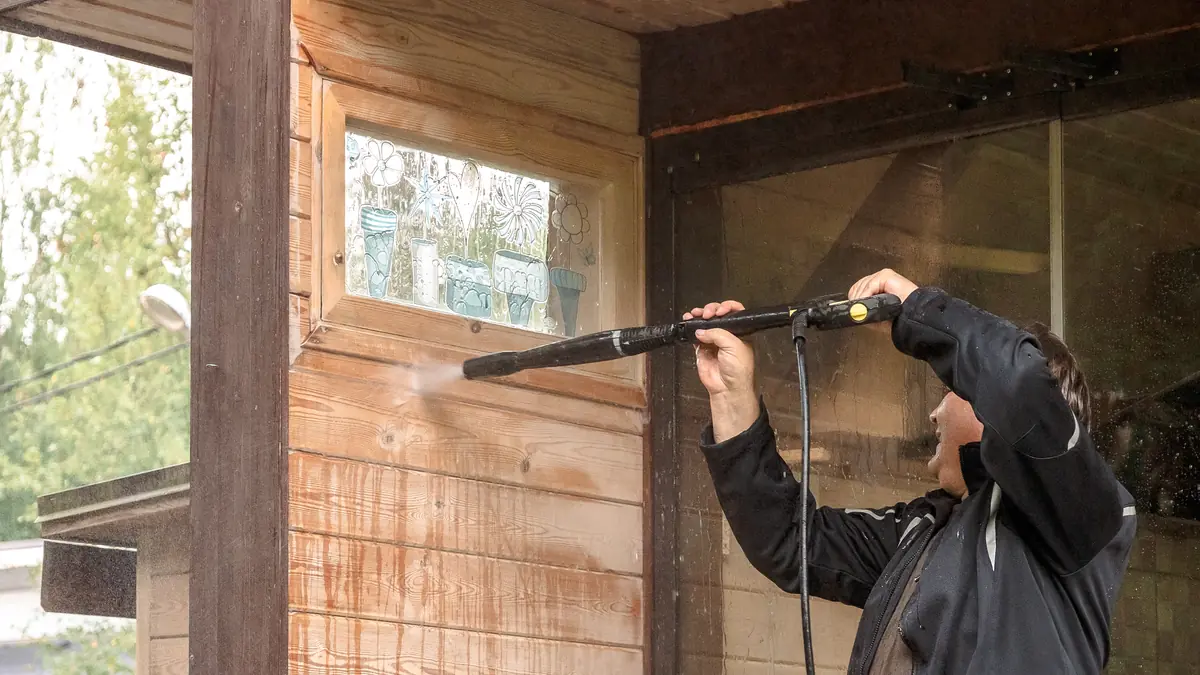
Short answer: soft wash the house, pressure wash the ground. Siding, roofs, painted wood, stucco, and anything that can dent, gouge, or hold water gets a low-pressure cleaning solution and a rinse. Concrete, pavers, and unpainted brick get high pressure. Most homes in Washington Township need both on the same visit, and the wrong one on the wrong surface is how siding gets water behind it and roofs lose years of life.
What pressure washing is
Pressure washing uses water alone, or water with a mild detergent, pushed through a narrow nozzle at 1,500 to 4,000 PSI. The force does the work. It is the right tool for hard, flat, mineral surfaces that can take it: a concrete driveway stained with tire marks and oil, a paver patio with moss in the joints, a stone retaining wall, a sidewalk gone gray.
Used on the wrong surface, that same force strips paint, etches soft wood, chips mortar, drives water up behind vinyl siding, and blasts the protective granules off asphalt shingles. Roofing manufacturers say pressure washing a shingle roof shortens its life and can void their coverage, which is why the Asphalt Roofing Manufacturers Association recommends low-pressure cleaning only.
What soft washing is
Soft washing flips the equation: low pressure, strong chemistry. The solution is applied at under 500 PSI, usually 100 to 300, about the force of a strong garden hose. The mix is typically sodium hypochlorite (the active ingredient in household bleach, diluted), a surfactant that helps it cling to vertical surfaces, and sometimes an algaecide. It sits for several minutes and kills the growth at the root, then everything is rinsed with plain water at low pressure.
Because it kills the organism instead of blasting the top layer off, a soft washed surface stays clean longer. A pressure washed siding wall often greens back up the next summer because the spores are still there.
What the green and black streaks on your house are
Knowing what you are looking at tells you which method you need.
- Green film on siding, usually the north side and anywhere under trees, is algae. It feeds on moisture and shade. Soft wash.
- Black streaks on the roof are a cyanobacteria called Gloeocapsa magma. It eats the limestone filler in shingles and spreads downhill with rain. Soft wash only, never pressure.
- Black or gray spots on siding, soffits, and painted trim are mildew. It thrives in humid summers like ours. Soft wash.
- Green moss in paver joints and on concrete is moss. Pressure wash, with a treatment to slow it coming back.
- Gray, dull concrete is dirt and oxidation. Pressure wash with a surface cleaner for an even finish.
- Rust streaks from sprinklers or railings are mineral stains, not growth. These need a specific rust remover and neither method alone fixes them.
Surface by surface: a typical South Jersey home
Most houses around Sewell, Turnersville, and Blackwood have the same handful of exterior surfaces. Here is the method for each.
| Surface | Method | Why |
|---|---|---|
| Vinyl siding | Soft wash | High pressure forces water behind the panels and can mark the finish. The algae comes off with the solution and a rinse. |
| Aluminum siding | Soft wash | Pressure strips the chalky oxidized paint and dents panels. |
| Painted wood siding and trim | Soft wash | Pressure lifts paint and furs the wood grain. |
| Fiber cement (Hardie) | Soft wash | Durable, but pressure can erode the factory finish at the edges. |
| Stucco and EIFS | Soft wash, very low pressure | Pressure blows holes in stucco and EIFS cannot take water intrusion. |
| Asphalt shingle roof | Soft wash only | Pressure strips the granules that protect the shingle from UV. |
| Brick (unpainted) | Pressure, moderate | Brick takes it, but old soft mortar can blow out; a pro lowers the pressure near joints. |
| Painted brick | Soft wash | Treat it like painted wood. |
| Concrete driveway, sidewalk, pool deck | Pressure with a surface cleaner | Only force removes embedded grime evenly without stripes. |
| Paver patio and walkway | Pressure, then re-sand joints | Pressure cleans pavers well but blows the joint sand out, which must be replaced. |
| Wood deck and fence | Soft wash or low pressure with a wide fan | High pressure furs the wood. A cleaner plus a gentle rinse brightens it safely. |
| Composite decking | Soft wash | Pressure can scar the cap layer. |
| Gutters (exterior face) | Soft wash, sometimes a brightener | The black tiger stripes are oxidation and need chemistry, not force. |
Both methods live on our power washing page: a soft wash section for the house and roof, and a concrete pressure washing section for the ground. On most jobs we do both in one visit.
What about my plants, pets, and windows?
This is the question people ask most about soft washing, and it is a fair one because the solution is bleach based. Here is how a careful crew handles it:
- Shrubs and beds under the work area get soaked with plain water before, during, and after. Wet leaves do not absorb the solution; dry ones can.
- The mix is diluted far below what people assume, and it is rinsed thoroughly. On a normal house wash, rinse water reaching the beds is too weak to harm established plants.
- Keep pets inside and move patio cushions, grills, and cars away from the house.
- Windows get rinsed last. The surfactant can leave a film if it dries, so a final clean-water pass matters.
- Close windows and tell the crew about any that do not seal well.
How often each one is needed in a humid New Jersey climate
South Jersey summers are humid and a lot of lots here are wooded, so growth comes back faster than the national averages suggest. A soft washed house typically stays clean for one to two years, longer on open sunny lots and shorter on shaded north faces. Driveways and patios show dirt again in about a year. Roofs stay clean for several years after a proper soft wash. We cover the full calendar in how often you should power wash your house.
Why a painter cares: soft washing before exterior paint
Here is the part the equipment guides skip. We are painters first, and the number one reason exterior paint fails early is that it was applied over mildew, chalk, or dirt. Paint sticks to the layer under it, and if that layer is algae, the paint peels when the algae lets go.
So every exterior painting job we do starts with a soft wash, then one to two days of drying before the first coat. The chemistry kills the mildew so it does not grow through the new paint, and the low pressure means we are not blasting water into the siding right before sealing it. If you are getting quotes for exterior paint and the painter does not mention washing, ask.
Can you DIY either one?
Pressure washing a driveway with a rented machine and a surface cleaner attachment is a reasonable weekend project. Keep the wand moving, use a 25 or 40 degree tip, and never point it at siding, windows, or people.
Soft washing is harder to do well at home. The pump sprayers sold at box stores do not deliver enough volume, the chemistry has to be mixed right, and a roof is not a place to learn. If you want to try the siding yourself, a hose-end house wash product and a soft brush on a pole will take care of light algae on a one-story home. For a roof, two stories, or anything stucco, call a pro.
Get your house and driveway on one estimate
Send a photo of the worst wall and the driveway to (609) 564-2519 or request a free estimate. We will tell you which surfaces get which method, and if you are thinking about exterior paint, we will quote the wash as the first step of that job. 10% off any job over $2,500.
Soft wash vs pressure wash questions
Is soft washing safe for vinyl siding?
Yes, and it is the recommended method. The low pressure cannot force water behind the panels, and the solution removes algae and mildew without marking the finish.
Can you pressure wash a roof?
No. High pressure strips the granules from asphalt shingles and shortens the roof's life, and most shingle manufacturers exclude it from their coverage. Roofs are soft washed at low pressure only.
What PSI is a soft wash?
Under 500 PSI, usually 100 to 300, roughly a strong garden hose. Pressure washing runs 1,500 to 4,000 PSI or more.
Will the soft wash solution kill my plants?
Not when the crew wets the plants before and rinses after. The solution is diluted and the rinse water reaching your beds is weak. Established shrubs and lawns are fine; we take extra care around delicate annuals.
Does soft washing cost more than pressure washing?
Usually a bit more per square foot because of the chemistry and the care involved, but it lasts longer because it kills the growth instead of trimming it. On most homes the two are quoted together as one visit.