
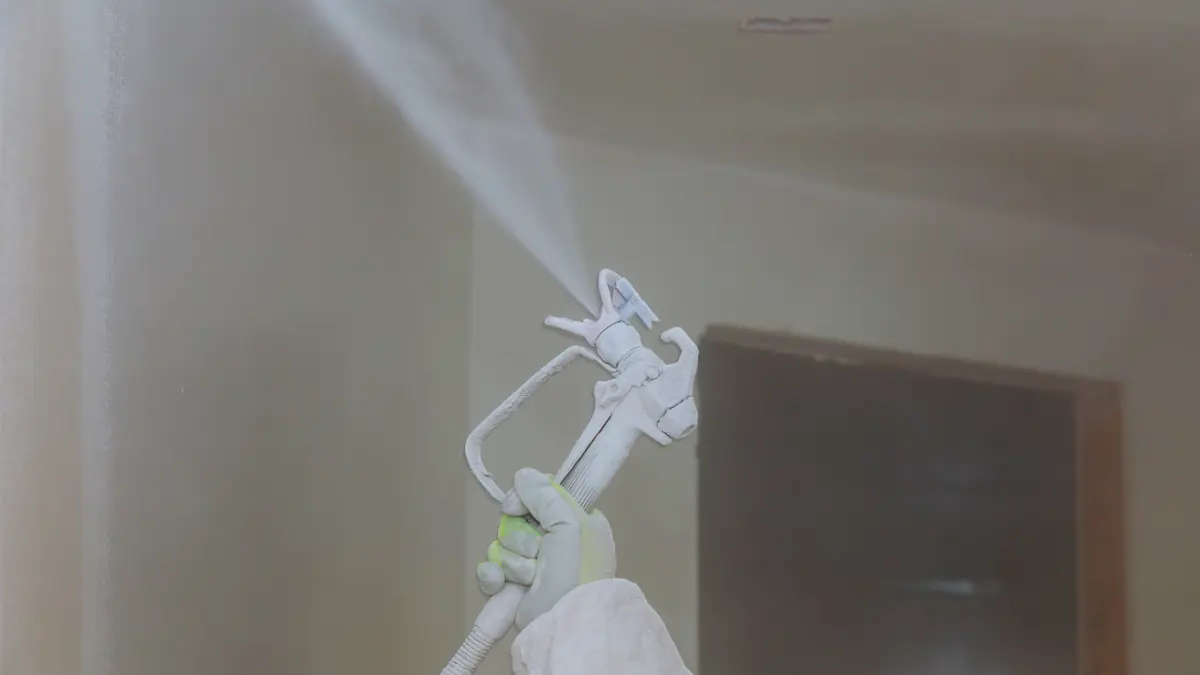
Short answer: yes, for most unfinished basements it is the best value in the house. A sprayed black ceiling hides the joists, ducts, wires, and pipes, keeps every inch of ceiling height, and costs a fraction of drywall or a drop ceiling. The catches are real but manageable: the room reads darker, dust shows, and spraying overhead is the most exhausting painting job there is. Here is how to decide, what to use, and the honest DIY versus pro comparison nobody else publishes.
Why black works on an exposed ceiling
Paint the joists, ductwork, and plumbing one dark color and the eye stops picking out the individual pieces. The ceiling becomes a single flat plane that recedes. That is why the look is everywhere in finished basements, restaurants, and gyms. Specifically, a black ceiling:
- Hides everything: joists, subfloor, HVAC trunk lines, wiring, drain pipes, the old nail plates.
- Keeps your ceiling height. Most South Jersey basements are 7 to 8 feet to the joists. A drop ceiling takes 3 to 6 inches you do not have.
- Leaves everything accessible. No panels to remove when a pipe leaks or you run a new cable.
- Costs less than any other finish, including a drop ceiling, and far less than drywall.
- Looks intentional. A gym, media room, playroom, or workshop reads as designed rather than unfinished.
The downsides, honestly
- It makes a dark room darker. Black absorbs light, so you need more fixtures than you would with a white ceiling. Plan the lighting before you paint.
- Dust shows. Cobwebs and dust on black joists are visible in a way they never were on raw wood. A quick pass with a duster a couple of times a year handles it.
- It is a huge amount of paint. Bare wood and plywood soak it up. Published DIY accounts used 2 gallons of paint plus four cans of primer for about 650 square feet, and 6 gallons for about 1,500 square feet.
- No sound dampening. An exposed ceiling, black or not, lets every footstep through from upstairs.
- It is hard to undo. Painting a black ceiling white later takes three or more coats.
True black vs soft black
This is where most DIY posts spend their time, and the consensus is clear: a soft, slightly warm black usually looks better than a pure jet black. True black can go flat and lifeless under warm LED light and shows every dust speck. Soft blacks with a touch of brown or gray (the ones named most often are Sherwin-Williams Black Fox, Iron Ore, and Urbane Bronze, and Benjamin Moore Black Ink) read as black from across the room but have some depth up close.
Our rule of thumb for local homes: in an older basement with lots of plumbing and uneven joists, go darker and flatter so the mess disappears. In a newer Washington Township build with clean I-joists and tidy ductwork, a charcoal or soft black can look more finished and keeps the room brighter.
Sheen: flat, always
Use a flat or matte finish. Flat hides the texture of rough lumber, the seams in the subfloor, and the ducts' ridges. Anything with sheen reflects light off every surface at a different angle and makes the ceiling busy again. One of the top-ranked guides suggests satin or semi-gloss; we disagree, and so does every painter we know. If you worry about dust clinging, a scrubbable flat or a matte is the answer, not a sheen.
How a professional does it
Here is the process behind every basement ceiling spraying job we do. The prep is where the time goes.
- Clear and cover. Everything out of the basement or into the center under plastic. Floors, walls, stairs, and finished areas get masked. Overspray from a black ceiling travels, and it does not come off carpet or a furnace.
- Protect the mechanicals. HVAC returns and supply registers are sealed. The furnace, water heater, electrical panel, smoke detectors, and any data or coax ends are wrapped. Light fixtures come down or get bagged.
- Electrical check. Open junction boxes get covers before paint, and we flag anything that looks wrong so an electrician can see it while it is still accessible.
- Vacuum and dust. Decades of dust on top of the joists. Paint over it and it falls later.
- Prime the bare wood. A primer coat, or a paint-and-primer product, cuts the finish coats from four or five down to two.
- Spray. An airless sprayer, two coats, from several angles so the sides of every joist and the back of every pipe are covered. A roller cannot reach those.
- Ventilate and return. Fans running, masking down, fixtures back up.
DIY vs pro: cost and time
The DIY blogs that rank for this are honest that it is brutal work. What they do not give you is the comparison.
| DIY | Professional | |
|---|---|---|
| Materials | About $200 for a 1,500 square foot ceiling (paint, primer, masking) plus a sprayer rental or purchase of $100 to $400 | Included |
| Time | 10 to 12 hours of spraying, plus a full day of prep and a half day of cleanup, overhead the whole time | One to two days, crew of two |
| Equipment | Consumer sprayer, respirator, suit, goggles, ladder | Airless rig, proper respirators, scaffolding where needed |
| Biggest risk | Overspray on finished surfaces, breathing it, missing the backs of pipes, fatigue | Choosing a painter who rolls instead of sprays |
| Typical cost | $300 to $600 and a lost weekend or two | Priced per square foot; most basements fall between a drop ceiling and drywall, and quoted free in person |
When to hire it out: if the basement has a finished area or carpet nearby, if there is a lot of old wiring, if you have asthma or anything else that makes a respirator a problem, or if the ceiling is more than about 600 square feet. Below that, with a bare concrete floor and nothing to protect, DIY is realistic.
The South Jersey moisture question
Basements around here run damp in summer. Before painting, run a dehumidifier for a week and check for active leaks. Paint will not fix a wet joist, and a dark ceiling hides water stains that would have warned you. Use a paint with mildew resistance in the formula, and keep the dehumidifier running afterward. If there is visible mold on the joists, it has to be cleaned and dried before any paint goes on, not covered.
Lighting plan before you paint
Figure the lighting out first. Black ceilings want more fixtures than white ones, spread evenly, and placed so they light the floor and walls, not the ceiling. Surface-mounted LED cans or track lighting on the joists work well and can be painted black to disappear. Warm white (2700K to 3000K) keeps a black ceiling from feeling like a parking garage.
Get a number for your basement
Measure the floor, count the fixtures, and request a free estimate or text a photo of the ceiling to (609) 564-2519. We will tell you what prep it needs and whether black or a soft charcoal suits the space. 10% off any job over $2,500.
Black basement ceiling questions
Does a black ceiling make a basement look smaller?
Usually the opposite. A dark ceiling recedes and the joists and ducts stop registering as objects, so the room reads taller and cleaner. It does read darker, which good lighting fixes.
What is the best paint for an exposed basement ceiling?
A flat or matte latex, ideally a paint-and-primer product with mildew resistance, in a soft black or charcoal. Flat hides the texture and seams. Avoid sheen.
Can you roll a basement ceiling instead of spraying?
You can for a small, simple ceiling, but a roller cannot reach the sides of joists, the backs of pipes, or around ductwork, so it takes much longer and still misses spots. Spraying is the standard.
Is it safe to spray paint near the furnace and electrical panel?
Yes, when they are sealed and wrapped first, the returns are blocked, and the space is ventilated. Open junction boxes should get covers before painting. This is a big part of why many homeowners hire it out.